

Teguh Anantawikrama. Foto: Dolumentasi pribadi/ukmdanbursa.com.
By Teguh Anantawikrama
Vice Chairman of the Indonesian Chamber of Commerce and Industry (KADIN)
Chairman for Technology and Digital Transformation
UKMDANBURSA.COM – The concept of Indonesia Incorporated is a call for all elements of the nation—government, business, and society—to move together as one strategic entity in building an economy that is both sovereign and prosperous for its people. For this vision to materialize, the public and private sectors must walk hand in hand, united by a single purpose: to achieve welfare and national economic independence.
However, this spirit cannot thrive if ministries and agencies remain confined within sectoral egos. True synergy can only emerge when bureaucratic silos are dismantled and replaced by cross-sector collaboration that accelerates business processes and prioritizes tangible outcomes.
Read more:
Trump Recognizes Prabowo’s Peace Diplomacy and Indonesia’s Independent Rise
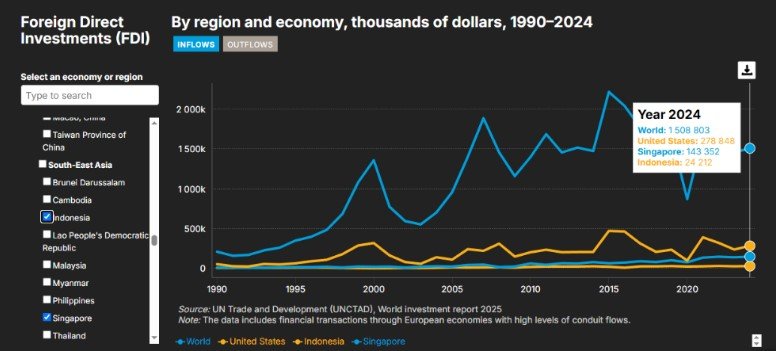
FDI to the United States has surged in recent periods, while inflows to Singapore and Indonesia have risen modestly up to 2024. Source: UNCTAD and other sources / ukmdanbursa.com.
Speeding Up Business and Budget Absorption
The first step is to establish mission-oriented collaboration mechanisms across ministries. The success of one sector should be measured by its impact on others. For example, the achievements of the Ministry of Industry in attracting manufacturing investment must be linked with the Ministry of Manpower in preparing skilled labor, and the Ministry of Finance in providing fiscal incentives.
By introducing shared KPIs (Key Performance Indicators), the government can ensure that every program moves toward a common purpose—not merely executing budgets, but generating real economic multiplier effects. It is time to redefine the metrics of development success—from budget absorption to impact absorption. This means shifting the focus toward measurable outcomes such as job creation, productivity growth, and national competitiveness.
Impact-based governance will foster efficiency, innovation, and accountability across institutions. Every rupiah spent from the state budget must be assessed not by how quickly it is spent, but by how much it contributes to improving the people’s welfare.
Creating a Stronger Multiplier Effect
According to the Organisation for Economic Co-operation and Development (OECD) Economic Outlook 2024, Indonesia’s real Gross Domestic Product (GDP) is projected to grow 4.7% in 2025 and 4.8% in 2026, slightly lower than 5.1% in 2024. The International Monetary Fund (IMF) forecasts an unemployment rate of 5.2% in 2024, improving slightly to 5.1% in 2025.
This suggests that while Indonesia’s fundamentals remain strong, economic acceleration will depend on generating a stronger multiplier effect—and this is where the Indonesia Incorporated paradigm becomes essential.
Employment data shows that 212 million Indonesians are of working age, with an employment rate of around 66%. The trade sector absorbed an additional 980,000 new jobs, agriculture 890,000, and manufacturing 720,000 (BPS, 2025). This underlines the importance of cross-sector synergy to ensure that new jobs are full-time, productive, and value-driven.
Focusing on Priority Sectors
In line with the government’s Asta Cita agenda—which emphasizes food sovereignty, industrial transformation, green economy, and digital acceleration—Indonesia’s growth in the medium term will hinge on four key sectors:
1. Digital Economy and Technology — Projected to contribute up to 20% of GDP by 2030, this sector is creating millions of new jobs and driving innovation.
2. Value-Added Manufacturing and Clean Energy — Downstream mineral processing, Electric Vehicle (EV) battery production, and biofuels strengthen Indonesia’s position in global supply chains.
3. Modern Agriculture and Inclusive Agribusiness — Enhancing productivity and reducing regional disparities.
4. Services and Tourism — Major job creators with direct impact on Micro, Small, and Medium Enterprises (MSMEs), logistics, and local economies.

Indonesia Incorporated is not a slogan—it is a new paradigm for national development. Concrete steps must include:
• Breaking sectoral barriers through policy interlink maps and shared KPIs.
• Transforming government performance metrics toward impact-based measurements.
• Empowering businesses as primary development partners through impact-based incentives and real ease-of-doing-business reforms.
• Integrating inter-agency data systems to measure multiplier effects and guide evidence-based policymaking.
This approach will empower the private sector to invest, innovate, and create jobs, while ensuring that public policy truly serves national welfare.
Read more:
The Need for Unfiltered Input and the Courage to Face Bitter Truths
Indonesia stands at a critical crossroads. With a large productive population, abundant natural resources, and a strategic role in global supply chains, the country has all the ingredients to become a major economic power.
Yet success will only come if Indonesia Incorporated is translated into concrete action—through cross-sector collaboration, impact-oriented governance, and a shared commitment to build a nation that is economically sovereign and socially just. ***




12 thoughts on “Putting “Indonesia Incorporated” into Action: Driving Synergy for Speed and Sustainability”